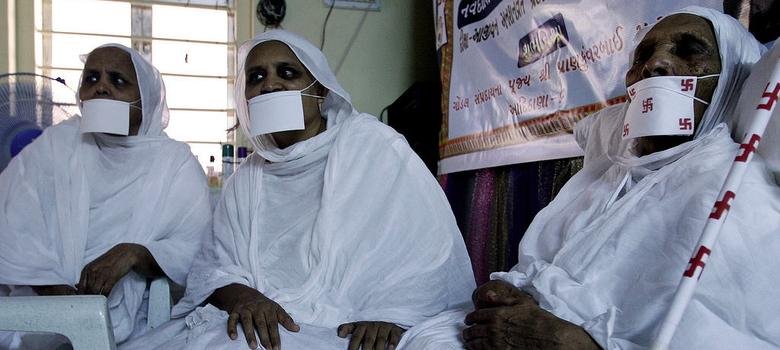
It is said that worldwide, there are diverse attitudes toward life and death. Jain religion followers engage in one of the more fascinating life-intensifying actions in the subcontinent, referred to as Santhara or Salekhna, which translates as “fasting unto death.” In this practice, followers will voluntarily stop eating in the support of their spiritual beliefs.
Santhara
Those Jains who wish to die peacefully fast till death under Santhara, a special rite for Jains. It’s a choice of many Jains, particularly the elderly, people dying from a chronic illness, and is not an obligation nestled deep into the dogmas of religion.
A case is that of Sayar Devi Modi, the 88-year-old woman, who was diagnosed with uterine cancer and chose not to undergo any treatment. How do you explain it? She resolved to fast until she died.
Reports suggest that, every year, between 200 and 500 Jains embrace Santhara and leave this world with a spiritual attitude away from attachment.
The controversy regarding Santhara, legal and otherwise
The debate about this practice began with legal and ethical questions. Critics of it claim that it is equivalent to suicide. The matter has even reached the Indian Supreme Court, where a petition has been filed to outlaw Santhara, but as yet, it has yet to reach a conclusion.
But said, the Jains believe that Santhara is honorable and sacred; it’s sheer hypocrisy to mistake it for a simple and plain suicide. They insist that it is one of liberation, made voluntarily, with consciousness toward the after life——while such an act might seem desperate.
Jainism and Its View of Life
Jainism is a religion that, in over 2,500 years of its existence, teaches non-violence. Unlike many other faiths, it does not believe in a supreme god, but, instead, Jains maintain that the soul should be perfect or liberated.
Most of Jains are strict vegetarians and see themselves to lead a life of peace. According to available data, there are more than five million Jains in India, a good portion of whom are very highly educated and wealthy. Jain religious leaders are widely respected; even Indian Prime Minister Narendra Modi paid homage to a Jain temple.
Is Santhara a general spiritual practice, or is it a controversial ritual?
Santhara is not about dying and is instead an intentional renunciation of worldly attachments-a conscious way to take leave of this life and waft out of the worldly sphere with a clear mind to obtain spiritual freedom, rather than clinging to the world’s values.
Those who undertake this practice are mainly older or terminally ill. The individuals undergoing Santhara are seen gradually deteriorating and dying. Devoting families often accompany their dear ones reciting spiritual hymns and prayers as they leave to die.
Last words:
Santhara, in many ways, is one of the most debated and talked-about religious practices among the Jains. While some argue that it is a dignified departure from life, others profess that it is a sheer ritualistic suicide.
Then, how can one pose the vital question. Should it acknowledge Santhara to be a dignified spiritual farewell or should it rather be reconsidered from a legal and ethical perspective?